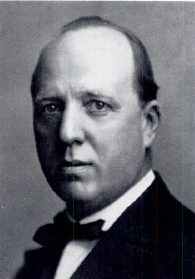
ferrata

Adolfo Ferrata 1880-1946

It is now a little over a year since Adolfo Ferrata, the great Italian hematologist, died in Pavia where he was professor of Clinical Medicine. Ideas, methods of research, diagnosis and therapy have changed and progressed enormously form the days when Ferrata started his activity in the field of blood diseases. However, his contributions to the knowledge of blood morphology and his work as a writer of several textbooks of hematology deserve to be recalled now that he is no longer with us. His reputation was international.
The first hematological work of Ferrata was done after a brief period of activity with J. Morgenroth, under the direction of, and in collaboration with, A. Pappenheim, in Berlin (1910-11). The investigation of the blood cells at that time was strongly influenced by the work of Paul Ehrlich, who had introduced the first straining methods for blood. Pappenheim and Ferrata, opposing the dominant opinions held by Ehrlich, Pinkus, Lazzarus, Naegeli, Denys, Levaditi and with minor variations by Grawitz, Weidenreich and Leowit that the “great mononuclear” was the first morphological step in the evolution of the “polynuclears” were able to demonstrate that the “mononuclear cells” of Ehrlich were an independent strain of white cells, and they introduced for these cells the denomination, thereafter universally accepted, of “monocytes” (1910).
The study of the origin of the monocytes led Ferrata to confront the baffling problem of the genesis of white cells in general. In a previous paper he had agreed with Pappenheim on the genesis of the monocytes from the lymphocytes (1910).
Soon after, however, Ferrata modified his views, and showed that a nongranulated immature cell, of lymphocytic appearance, may be found in the bone marrow and in the lymph nodes. He believed that this cell was the common progenitors of the red cells, the white granulated cell of the marrow, the monocytes and the lymphocytes. For this stem cell he created the name “hemocytoblast”, from then on used by the majority of the hematologists, although not always with the same significance. His hemocytoblast in the marrow is morphologically indistinguishable from that in the lymph nodes, but it is different in its potentiality of maturation into respectively a medullary white cell, a red cell or a lymphocyte. He was thus recognized as a “neounitarian” among the theorists of hematology. The hemocytoblasts of Ferrata (1912-18) is the “free primitive blood cell” of Cunningham, Sabin and Doan (1925). Although legitimate doubts may be raised as to whether or not hemocytoblasts, morphologically identical to those of the bone marrow (nongraulated myeloblasts), are to be found in the normal lymph nodes of the adult, it is a fact that a differentiation between the stem cells of the medullary elements and those of the lymphocytes is not easy, as everyday experience in the leukemias with highly undifferentiated elements shows. Nowadays clinical clinical hematologists have found an easy but not very scientific way out of these difficulties: they call the immature nongranulated cells “blasts”.
The progress made in the knowledge of blood morphology and blood genetics could not fail to influence conception of blood pathology. Panchromatic staining methods for blood cells had been proposed since the turn of this century (Jenner 1899, Wright 1902, May-Grunwald 1902, Giemsa 1902) and with the aid of this technic it had been almost universally recognized that the cells present in the peripheral blood of leukemic patients were to a far greater extent immature rather than abnormal cells. On the other hand Banti had maintained that leukemias are neoplastic diseases, not fundamentally different from sarcomas and had defended his thesis with anatomophatological evidence in his “Handbook of Phatological Anatomy” (1907) and in a report to the Italian Phatological Society (Pisa 1913).
In the discussion which followed this report, Ferrata and Micheli, two young men at that time, rose to oppose the view of Banti, who recognized, at least in part, the validity of their evidence. In the last years of his life Ferrata was no longer so sure of the essential character of leukemias as hyperplastic processes to be differentiated from true neoplastic diseases, and in recent years some of his pupils even advanced doubts about the systematic nature of the various leukemic lesions, unearthing ideas stubbornly defendant by Banti in the past. Multa renascentur quae jam cecidere, indeed! All this is good testimonial of the mental alertness, scientific honesty and intellectual elasticity of Ferrata.
The name of the Italian hematologist has remained bound to a special type of cell which many authors, after Naegeli, have called the Ferrata cell. According to Ferrata, these elements, which he first saw in leukemic blood (Ferrata and Franco 1919, Ferrata 1924), represent undifferentiated (multipotent) connective tissue cells. Ferrata called them hemohistioblasts , implying that they were cells capable of an evolution in both directions really exist. They are the reticulum cells of the blood-forming organs and possibly of other more widely distributed cells (adventitial cells of the blood capillaries, etc.).
The significance of the particular elements described in the peripheral bood by Ferrata under the name of hemohistioblasts has been strongly debated and their existence as such even denied by some authors (Ringoen, Lambin). The writer showed that cells like those described by Ferrata in leukemic blood are also found in the bone marrow of normal human subjects and of mammalians in general (1928). That they are not artifacts, i.e. damaged promyelocytes and myelocytes, as postulated by Ringoen and Lambin, is proved by their size (which in many cases is far larger than that of the promyelocytes or myelocytes), their nuclear structure and particulary by the fact that large elements with cytoplasmic pseudopodia, with two blow-up nuclei, with two or three nucleoli, may be seen also in bone marrow section, often with specific granulation in the cellular body. They represent a form of early differentiation of the reticulum cells into granulocytic elements.
This writer, however, has shown that their cellular characteristics are not those of the fixed, pluripotent cells of the connective tissues (reticulum cells), which are the hemohistioblasts in Ferrata’s sense. Both in the second edition of this book (1933) and through the work of one of his pupils (Vills 1929), Ferrata accepted this point. Thus it should be organized that Ferrata not only created an appropriate name expressing a correct idea (hemoistioblasts) but that he gave also the first description of a hitherto undescribed type of evolution of the reticulum cell. Similar stages of direct differentiation of the reticulum cells into megaloblasts have also been described by the school of Ferrata in Pericious anemia and acute erythremia (Di Guglielmo).
The contribution of Ferrata are almost totally in the field of morphological hematology. His influence in this direction on a large number of Italian and foreign hematologists, especially those of Spanish and Latin-American origin, was very pronounced. The origin of the blood cells and the relationship between the different cell types were submitted to a minute investigation under experimental conditions, in both normal humans and phatological material by Ferrata and these workers. Cases of blood disease were studied with an almost exclusive interest for the morphology of the blood cells in the peripheral blood, in the bone marrow, etc. Although the achievements in this field were by no means slight, hematology has a wider scope than pure cytological investigation. And yet Italian hematology has a tradition also of the physiologic approach to the study of blood diseases, from Bizzozzero, Marchifava, Banti down to Zoja, Mino, Greppi, Lattes, to name only the better known men. This extreme interests in the morphologic side of blood disorders was very evident in the work of hematologists of many nations at that time.
This may have been due to economic limitation which hinder more expensive methods of research. It certainly had a reason in the past. The evidence at hand, however is to the effect that, although an exact knowledge of blood morphology is a necessary tool for any good hematologists, future progress in the understanding of blood diseases will come from the physiologic approach to these problems.
The activity of Ferrat as a writer of monographs and handbooks started very early with the “Morphology of the Normal and Phatological Blood” (1912). This work was the forerunner of a more extensive handbook “Blood Diseases” (Le Emopatie, 1918-23) which, clearly written and magnificently illustrated with lithographic colored tables, had a tremendous success among physicians familiar with the Italian language in Europe and in Latin America.
Undoubtedly this book exercised a very great influence in developing interests in hematology in Italy. In the period between the World Wars, Ferrata in conjunction with several Italian authors (Di Guglielmo, Villa, Introzzi, Greppi, Artom and others) prepared a new edition in five volumes, which appeared between 1933 and 1935. It is to be regretted that this book is not more widely known.
Ferrata contributed a monograph on “The Disease of the Endocrine Glands” for the Italian “Handbook of Internal Medicine” (Milan 1931), and a “Manual of Blood Disease”, compiled in collabortion with his pupil E. Storti, has just appeared. This manual is also liberally illustrated with beautiful plates.
Ferrata had a long career as a teacher. In 1922 he was named professor of Medical Phatology at the University of Messina. He went to Siena in 1923 and the following year he was called to Pavia as Professor of Clinical Medicine. He created a school of Hematology and left behind a distinguished group of scientists, many of them now at the head of several university structures.
Clear minded and warm hearted, Ferrata was a strong personality and exercised a powerful influence beyond the sphere of his immediate activity. Both in his clinical lectures, as when speaking in medical meetings and congresses, his word was convincing and his intervention clarifying. His powerful physical build, the warmth of his Lombard elocution, the evident fairness which is characterized his approach to any controversy, all contributed to create an atmosphere of sympathetic agreement around him. Although not entirely exempt from the nepotistic habits prevailing in the Italian academic world Ferrata showed himself ready to help young men coming from other schools to realization of their academic aspiration.

M. Volterra, New York, 1946